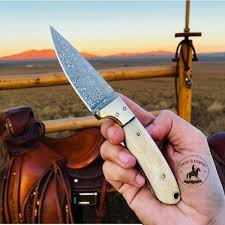

Classic does not always mean unchanged. Cowboy knives and Damascus knives show how traditional-looking designs can continue evolving without losing the qualities that made them recognizable in the first place.
That evolution is one of the most interesting parts of modern knife culture.
Cowboy Knives Can Look Traditional Without Feeling Old
The Western aesthetic is powerful because it is immediately identifiable.
Yet modern interpretations do not have to copy historical pieces exactly.
Designers can retain the recognizable spirit of Cowboy knives while experimenting with contemporary finishes, updated proportions, or different material combinations.
This creates a version of Western design that feels familiar without looking like a museum reproduction.
That distinction is important.
A classic-inspired object can respect its visual roots while still feeling relevant today.
Damascus Knives Help Push Traditional Designs Forward
Damascus knives are especially useful in this modern reinterpretation.
Patterned steel can be introduced into established knife silhouettes, giving them an entirely different visual effect.
The result can look traditional at first glance and contemporary on closer inspection.
This is how old design ideas survive.
They are not frozen.
They are adapted.
Modern Buyers Have Different Expectations
The modern knife enthusiast does not necessarily want a historical replica.
Some buyers want the atmosphere of traditional design but also appreciate originality.
Others are interested in handcrafted materials and unusual visual elements.
Some prefer minimalist designs, while others enjoy decorative craftsmanship.
That diversity has created space for many interpretations of Cowboy knives.
The Western identity can remain while the individual maker adds a personal creative direction.
Cowboy Knives Can Cross Design Boundaries
Western-inspired designs do not have to belong to one visual category.
A knife can contain traditional references while still appearing refined.
Another may lean toward rustic styling.
Another may combine Western proportions with modern steelwork.
That flexibility is part of the reason cowboy-inspired knives remain relevant.
The category is large enough to support interpretation.
Damascus Is a Bridge Between Craft and Contemporary Style
Modern Damascus knives occupy an interesting middle ground.
They can appear highly traditional because patterned steel has a long history in bladesmithing.
At the same time, contemporary makers use Damascus to create striking patterns that fit modern design aesthetics.
That combination gives Damascus a rare ability to work across different styles.
A Damascus blade can look appropriate in a traditional setting without appearing outdated in a modern collection.
Classic Design Survives Through Reinvention
Design history is full of examples where familiar forms remain popular because they can adapt.
The Western knife is one such example.
Its recognizable identity gives designers a foundation.
Modern craftsmanship then provides room for change.
The same principle applies to Damascus knives.
The concept of patterned steel can be applied to different shapes, visual themes, and interpretations.
The result is a category that keeps expanding instead of repeating itself.
Why “Modern Classic” Is the Right Description
A modern classic is not simply an old product that remains available.
It is a design that can survive because its central idea remains attractive while the details are allowed to evolve.
That is exactly what makes Cowboy knives so interesting today.
The Western influence remains recognizable, but the finished knife can look completely different from one piece to another.
Likewise, Damascus knives remain connected to historic metalworking traditions while continuing to evolve through contemporary bladesmithing.
Different Generations Can Appreciate the Same Knife
A younger collector might notice the unusual steel first.
An older enthusiast might appreciate the Western influence.
A designer might focus on proportions.
A craftsmanship enthusiast might be more interested in the making process.
One object can therefore appeal to people for different reasons.
That is a strong quality in any classic design.
It allows interpretation.
The Future of Cowboy Knives Is Not Stuck in the Past
The future of Cowboy knives does not require abandoning their Western identity.
Instead, it can involve exploring what that identity can become.
New materials, new finishing approaches, and combinations with patterned Damascus steel can produce designs that feel fresh while still carrying recognizable Western character.
That is how traditions stay alive.
They change without disappearing.
Damascus Knives Keep Expanding the Possibilities
The same applies to Damascus knives.
As makers continue experimenting with patterns, combinations, and blade styles, Damascus can appear in forms that previous generations could not have imagined.
The category therefore remains open-ended.
There is no single visual destination.
That creative freedom is part of its lasting appeal.
A Classic Can Be Familiar and Unexpected at Once
Perhaps that is the real connection between these two categories.
Cowboy knives provide a familiar cultural foundation.
Damascus knives provide a material language that can transform that foundation.
The result is a product that can look recognizable from a distance yet reveal something unexpected when examined closely.
For shoppers exploring specialty blades, KBS Knives Store offers an environment where Western-inspired design and distinctive Damascus craftsmanship can meet in modern interpretations.
A true classic does not survive because nobody changes it.
It survives because each generation finds a new reason to appreciate it.