
Townhouse Winter-Service Planning in Langley
A snow agreement can look comprehensive on paper while leaving one of the property’s most important surfaces poorly defined.
The parking areas may be listed. Sidewalks may have service triggers. Entrances may be included. Yet the internal road connecting those areas is sometimes described only as “access” or assumed to be part of general plowing.
That ambiguity is exactly what a private road snow removal contract should eliminate.
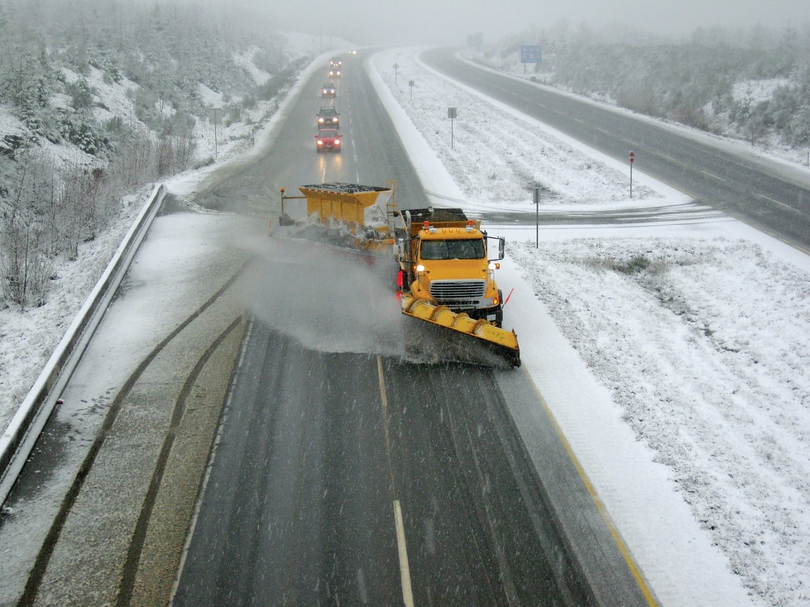
Private roads are not simply longer driveways. They may contain intersections, visitor parking entrances, narrow sections, speed-control features, drainage structures, fire-access areas, turning points, and stretches where parked vehicles reduce the usable width.
If the road is necessary for residents to reach their homes, contractors to reach service areas, or emergency vehicles to move through the property, its winter requirements deserve their own scope.
A complete agreement should identify where private-road service begins and ends, what constitutes completion, and which conditions may require another visit.
Otherwise, everyone may believe the road is included while imagining a different level of service.
Snow and Ice Support for White Rock Strata Properties
Coastal exposure introduces another issue: a private road may remain operational during snowfall but become more difficult later as water moves and temperatures change.
That makes ocean-facing property ice control planning particularly relevant to internal roads, slopes, intersections, and pedestrian crossings.
A road exposed to wet snow, rain, wind, or repeated meltwater does not necessarily present the same problem throughout an event. Mechanical clearing may restore access first. Later, runoff from snowbanks or higher ground can cross the road and refreeze in shaded sections.
A contract should therefore distinguish snow clearing from ice-control response.
It should also recognize that not every part of a private road behaves the same way. An exposed upper section may dry quickly while a sheltered bend stays wet. A low section near drainage infrastructure may collect meltwater. An entrance can experience different surface conditions from the interior route.
Good ocean-facing property ice control planning identifies these differences before they become recurring complaints.
The Road Ends at the Property Line—The Responsibility Does Not
Public-road snow operations and private-property winter service are separate systems.
For strata managers, assuming municipal crews will eventually solve an internal access problem can create a dangerous gap.
Map the Entire Travel Path
A contractor should receive a clear site map showing the road network that belongs within the service scope.
That map should identify entrances, internal intersections, narrow lanes, turning areas, fire routes, waste-collection access, visitor parking connections, and any place where equipment cannot safely perform a normal pass.
The point is not to make the contract unnecessarily complicated.
It is to remove uncertainty.
A private road snow removal contract works best when both parties can look at the same plan and agree on exactly which surfaces are covered.
Define What “Cleared” Actually Means
The word “cleared” can mean very different things.
Does it mean one pass down the center? Full usable width? Access to every parking section? Clearing around speed bumps? Treatment of icy corners?
Those expectations should not be discovered during a storm.
Service standards should reflect how the road is actually used and which portions are essential to property access.
Private Roads Need Their Own Service Standards
Trigger depth is important, but it is only one contract variable.
A private road can become difficult before deep accumulation occurs, particularly when grades, compacted wet snow, drifting, or refreeze are involved.
Managers should consider whether the contract defines priority sections, treatment expectations, repeat-service conditions, and timing after ongoing accumulation.
Snow placement also deserves explicit attention.
A long internal route can generate substantial piles. Those piles need locations that do not gradually reduce road width, block sightlines, interfere with parking, cover drainage, or restrict turning areas.
After several events, a storage location that worked early in the season may reach capacity.
That raises another contractual question: what happens when snow can no longer remain where crews normally place it?
A complete scope should explain whether relocation is included, separately priced, or handled only when authorized.
Without that clarity, storage problems can become access problems halfway through the season.
The Cheapest Scope Can Leave the Most Expensive Gap
A contract that excludes difficult sections may initially appear competitive.
The problem emerges when crews encounter them during an actual storm.
Equipment Access Changes the Price
Not every private road can be serviced efficiently by the same machine.
Tight corners, parked vehicles, decorative landscaping, narrow lanes, grades, gates, or limited turnarounds can slow production or require smaller equipment.
Those conditions should be evaluated before pricing.
If a bid assumes uninterrupted machine passes but the site repeatedly requires repositioning or hand work, either service quality or cost expectations will eventually be challenged.
Follow-Up Conditions Need a Rule
Completion at 5:00 a.m. does not guarantee the road will remain unchanged all day.
Additional snowfall can occur. Vehicles can compact new accumulation. Snowbanks can release meltwater. Temperatures can drop.
This is where service records become useful.
Only Strata Snow Removal uses GPS and photo logs to establish when crews attended and what conditions were documented. If a road was completed and later changed, the service history can help separate the original visit from the need for follow-up.
Proactive dispatch supports that distinction, while strict capacity limits help preserve the ability to return when conditions genuinely require it.
Defining Scope, Triggers, and Documentation
Before approving a winter contract, strata councils should be able to answer several practical questions.
- Which private roads are included?
- Where does contractor responsibility start and finish?
- What accumulation or condition triggers service?
- Which portions receive priority?
- Is ice control separate from plowing?
- Where will snow be stored?
- What happens when storage capacity is exhausted?
- How are blocked sections recorded?
- When does a changing surface condition justify another visit?
Those questions create a stronger winter scope than simply listing “road plowing” as one line item.
Only Strata Snow Removal’s strata-only focus is relevant because private roads rarely operate independently from the rest of a shared residential property. They connect parking, buildings, walkways, waste areas, visitor access, and other common infrastructure.
Large salt reserves support prolonged ice-control demand. GPS/photo records improve service documentation. A damage repair guarantee adds accountability around property impacts, while cancellation flexibility gives councils another practical contract consideration.
But the underlying lesson is simpler.
A private road is not an optional detail if the property depends on it.
It is part of the access network.
A complete winter agreement should treat it that way—from the first plow trigger to the final refreeze inspection.
Because a contract can include every parking stall and every walkway on the property and still fail at the most basic task if residents cannot reliably reach them.