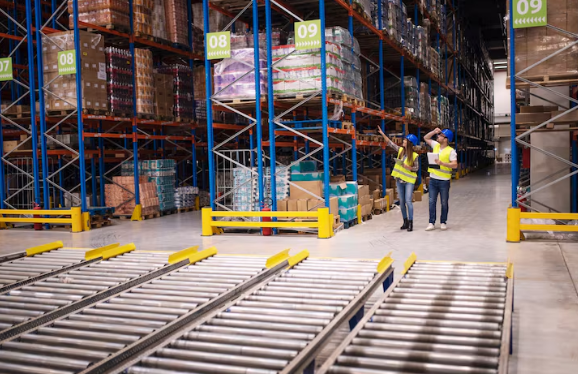

Five years ago, automation was something only the biggest players could justify. Now mid-sized distribution centers are installing systems that used to be reserved for national retailers, and the gap between “automated” and “manual” is starting to show up directly in delivery speed and labor costs. Working with a warehouse automation company early in that process tends to make the difference between a system that fits your operation and one you’re stuck adjusting for years.
What’s changed isn’t just the technology. It’s how accessible it’s become, and how many operators are realizing they can’t out-hire their way through peak season anymore.
Labor Shortages Pushed Automation Forward Faster Than Expected
A lot of warehouses didn’t automate because they wanted to. They automated because finding reliable seasonal labor got harder every year, and the cost of that labor kept climbing.
That shift changed how automation gets pitched internally. It used to be framed as a long-term efficiency play. Now it’s often framed as risk management, because a facility that can’t staff up during peak season has a real operational problem, not just a productivity one.
This is part of why smaller distribution centers are automating earlier than they would have a few years back. Waiting isn’t free anymore.
There’s also a retention angle that doesn’t get talked about enough. Warehouse work that’s purely repetitive tends to have the highest turnover, and high turnover means constant onboarding costs. Automating the most repetitive tasks doesn’t just fill a labor gap, it also frees up existing staff for roles that keep them around longer.
Warehouse Robotics Solutions Are No Longer Just for Massive Facilities
Robotics used to mean a huge capital investment and a facility built around it from day one. That’s not really true anymore.
Autonomous mobile robots and goods-to-person systems have gotten more modular, which means they can be added to existing layouts instead of requiring a full rebuild. A mid-sized facility can bring in a smaller robotics footprint, prove it works, and expand from there.
Warehouse Robotics Solutions are also getting smarter about picking accuracy, which matters more than speed in a lot of operations. A robot that moves fast but picks wrong creates more work than it saves.
The practical takeaway here is that robotics no longer require betting the whole facility on one system. You can start smaller and scale based on what actually pays off.
This matters most for operators who’ve been holding off because they assumed robotics meant an all-or-nothing decision. It doesn’t have to. A single zone running a smaller AMR deployment can prove out the ROI before anyone commits to expanding it facility-wide, which lowers the risk considerably compared to how these projects used to get approved.
Software Is Catching Up to the Hardware
For a while, warehouse automation had a software gap. The equipment could move fast, but the systems managing that equipment couldn’t always keep up with real-time decisions.
That’s shifted. Warehouse control and execution software now handle a lot of the coordination that used to require manual oversight, adjusting task priority, routing, and labor allocation on the fly instead of running on fixed logic.
This matters more than it sounds like it should. A facility with strong hardware and weak software ends up with equipment that’s underused, because the system isn’t smart enough to keep it busy efficiently. The software layer is often what separates a facility that’s technically automated from one that’s actually running efficiently.
This is also where a lot of automation budgets get misallocated. Operators sometimes spend heavily on the physical equipment and treat the software as an afterthought, when it should really be the other way around. The equipment is only as good as the system telling it what to do next.
Automation Is Becoming Part of Facility Design, Not an Add-On
For years, automation got planned after the building was already finished. Racking went in, dock doors were set, and then someone tried to fit a conveyor or robotics system into whatever space was left.
That approach is losing ground. More operators are involving automation planning during the warehouse automation design phase itself, before racking layout or dock placement is locked in. It’s a more expensive conversation to have upfront, but it avoids the compromises that come from retrofitting equipment into a building that wasn’t designed for it.
Facilities built with automation in mind tend to have better ceiling clearance planning, wider aisles where robotics need them, and power infrastructure that doesn’t need to be redone later. None of that is glamorous, but it’s the difference between a system that runs well and one that’s constantly working around the building instead of with it.
Data Is Driving Automation Decisions More Than Instinct
Operators used to make automation decisions based on gut feel and what competitors were doing. That’s changing too.
Facilities now have enough historical order data to model where bottlenecks actually happen, rather than guessing based on where things feel slow. That data shows whether a facility’s real problem is picking speed, sortation accuracy, or storage density, and each of those points toward a different automation investment.
This matters because a lot of wasted automation spend comes from solving the wrong problem. A facility with a storage density issue doesn’t need faster picking robots. It needs better racking and space utilization first. Getting that diagnosis right before spending money is worth more than most people expect.
If you’re trying to figure out where your own facility sits in that picture, it usually helps to talk it through with people who’ve seen the pattern before. You can Connect With Us to walk through your specific bottlenecks and figure out where automation would actually move the needle for your operation.
What This Means for Growing Distribution Centers
None of these trends mean every warehouse needs to automate everything at once. That’s still the wrong takeaway, even with how fast the technology is moving.
What it does mean is that the barrier to entry has dropped. Systems that used to require massive facilities and massive budgets are now accessible to operations that are still growing into their next phase. Waiting for a “perfect” moment to automate usually just means competitors get there first.
The operators getting the most value out of automation right now aren’t necessarily the ones spending the most. They’re the ones being specific about which problem they’re solving, whether that’s labor shortages, picking accuracy, storage density, or space efficiency, and choosing systems built around that answer instead of chasing every trend at once.
Distribution operations that treat automation as an ongoing part of how they plan their facility, rather than a one-time project, tend to stay ahead of the volume increases that catch everyone else off guard.